

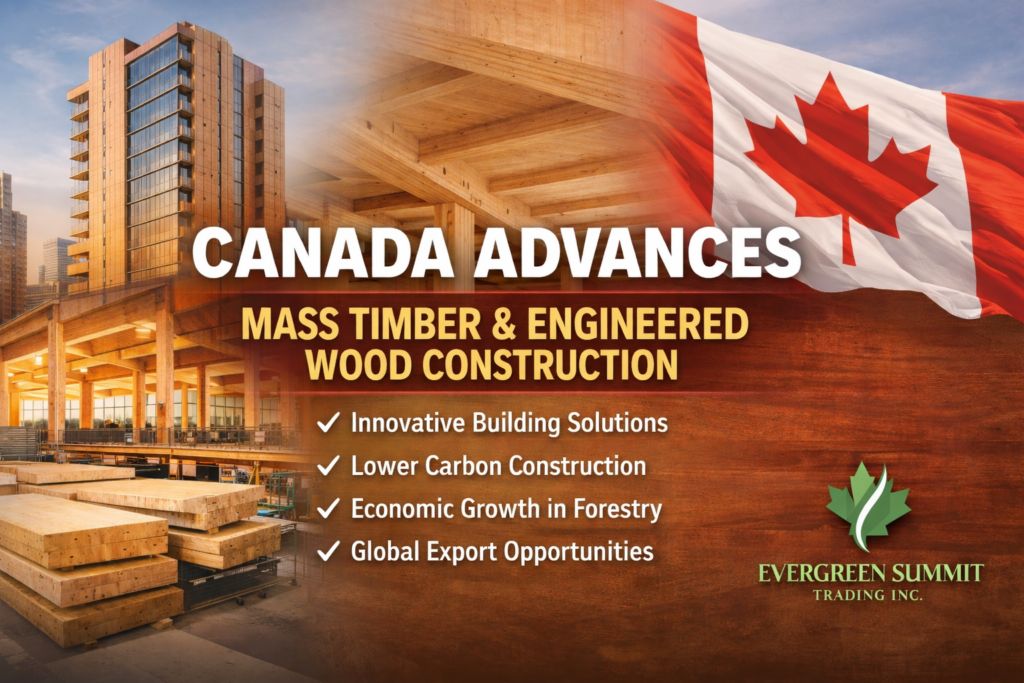
The Government of Canada has introduced a new set of measures to expand the use of wood in construction, with a particular emphasis on mass timber and engineered wood technologies. This initiative aligns housing development, climate policy, and industrial strategy within a unified framework.
Strategic Context
Canada’s forestry sector has long been a cornerstone of the national economy. However, traditional dimensional lumber markets — particularly in the United States — have faced persistent trade pressures and pricing volatility.
At the same time:
- Housing demand continues to rise
- Construction emissions are under increasing scrutiny
- Developers seek faster, cost-efficient building methods
- Global markets are prioritizing sustainable materials
Mass timber addresses each of these pressures simultaneously.
What Is Driving the Policy?
Mass timber technologies such as CLT, Glulam, and advanced engineered panels offer:
- Reduced embodied carbon compared to concrete and steel
- Faster on-site assembly
- Improved structural performance
- Design flexibility for mid- and high-rise buildings
- Alignment with net-zero construction targets
Federal support aims to accelerate adoption, modernize building codes, support research and commercialization, and increase domestic manufacturing capacity.
Economic & Export Implications
For companies engaged in wood export and international trade, this development has important downstream effects:
- Increased Value-Added Production
Canada is shifting up the value chain from commodity lumber to engineered systems. - Stronger ESG Credentials
Sustainability certifications and carbon-performance metrics enhance global competitiveness. - Expanded Product Portfolio
Exporters can increasingly offer structural systems, panels, and engineered components — not just dimensional lumber. - Market Diversification Opportunities
Countries investing in sustainable infrastructure and climate-aligned development are natural target markets for Canadian engineered wood.
For firms like Evergreen Summit Trading Inc., which focus on building export pathways for Canadian wood products, this policy shift strengthens long-term supply credibility and innovation capacity.
The Broader Industry Transition
The future of forestry is not purely about harvesting volume — it is about integrating:
- Innovation
- Engineering
- Certification
- Design collaboration
- Climate performance
Canada’s support for mass timber represents a strategic repositioning of the entire forest value chain.
In global markets where sustainability is increasingly embedded in procurement criteria, engineered Canadian wood is no longer optional — it is competitive infrastructure